
Exporting Data to the BigQuery Tables
Set up data export to tables to regularly update information about the audience, contacts' activity, and campaign results in BigQuery. Available datasets for export:
broadcastscontactActivitiescontactsdeviceseventsmessagesorderItemsordersrevenueworkflows
This information will update the data in the BigQuery tables up to twice a day after setting up.
How the Export Works
The daily queue starts at 00:00 UTC, and accounts are exported one after another, so the run for your account can begin at any point during the day. The run itself takes from a few seconds to about two hours, depending on how much data has changed, and BigQuery adds its own time to merge the temporary tables. Don't tie a job on your side to a fixed clock time — check the tables for new data instead.
After you set up the export, the first sync happens on the next scheduled cycle rather than immediately. If no data has appeared well after that window, check that the selected data sets actually have data to export for your account — for example, no data of that type may have been generated yet — before assuming the export is stuck. If the problem persists, contact support.
If an export fails, Yespo sends a notification by email and to the account's App Inbox (the bell icon in the top menu). The notification is sent no more than once a day. After the cause of the error is fixed, the next export resumes from where the previous one stopped.
The export list doesn't show the status or time of the last run: a notification tells you about a failure, and you can check the BigQuery tables for new data.
The first export isn't limited to the previous day: it includes the history your account already holds, and nothing has to be triggered manually. What it can't add is data that was never collected; see Exchanging Data with Google BigQuery for the depth each data set covers. For an account with a very large contact base, the first export can take several days, while later runs carry only what has changed and finish much faster.
You don't need to pre-create BigQuery tables. They're generated automatically at the first export and updated from then on, and their names correspond to the data sets. Alongside the main tables, temporary patch_<table name>_<UUID> tables appear during a sync: changes are uploaded there first, then BigQuery merges them into the main table and deletes the temporary one automatically. Neither main nor temporary table names can be customized. If leftover patch_ tables remain in the data set after a sync, contact support.
You choose the data sets and the columns to export, but not the rows — the export can't be filtered by a value, so every row of a selected data set is exported. A selection such as contacts with emailStatus = UNSUBSCRIBED has to be made on your side, in a query over the exported table.
The contacts data set is exported in full, with all contacts in the account, and it and broadcast data are synchronized for the entire lifetime of the account. contactActivities has a fixed depth limit — up to 90 days of contact activity, and no earlier than the moment activity collection was enabled for the account, so if collection was enabled later, the available depth is smaller. It isn't the only data set that can come up short: events and revenue aren't backfilled for the whole account history, and a data set whose table is recreated is filled from that moment onwards. Before you rely on an earlier period, ask support for the depth available for that data set.
Numbers taken from contactActivities don't match the campaign report, and they aren't meant to. Every open is written as a separate row, while the report counts unique opens — one per contact, so a query over the export returns more activity than the report shows. To get close to the report, take one status per contact and iid — the identifier of a particular send. The numbers still won't match exactly.
Creating Data Export
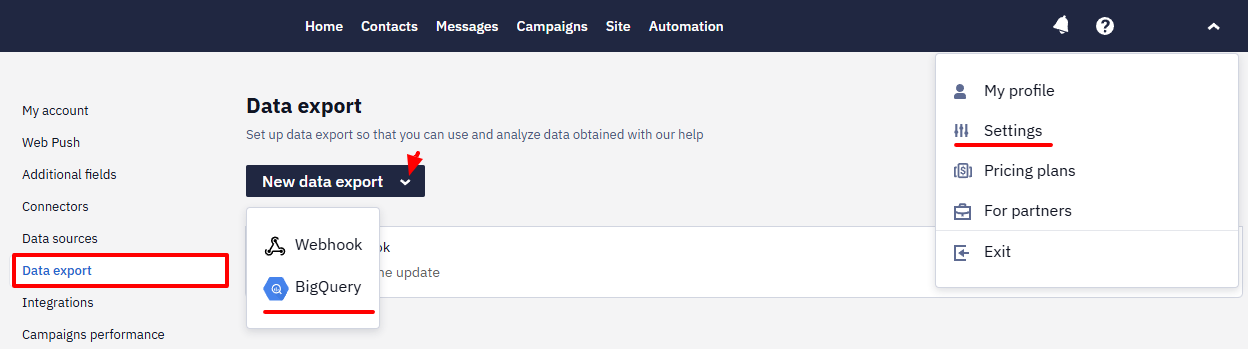
- Go to Settings → Data Export → BigQuery.
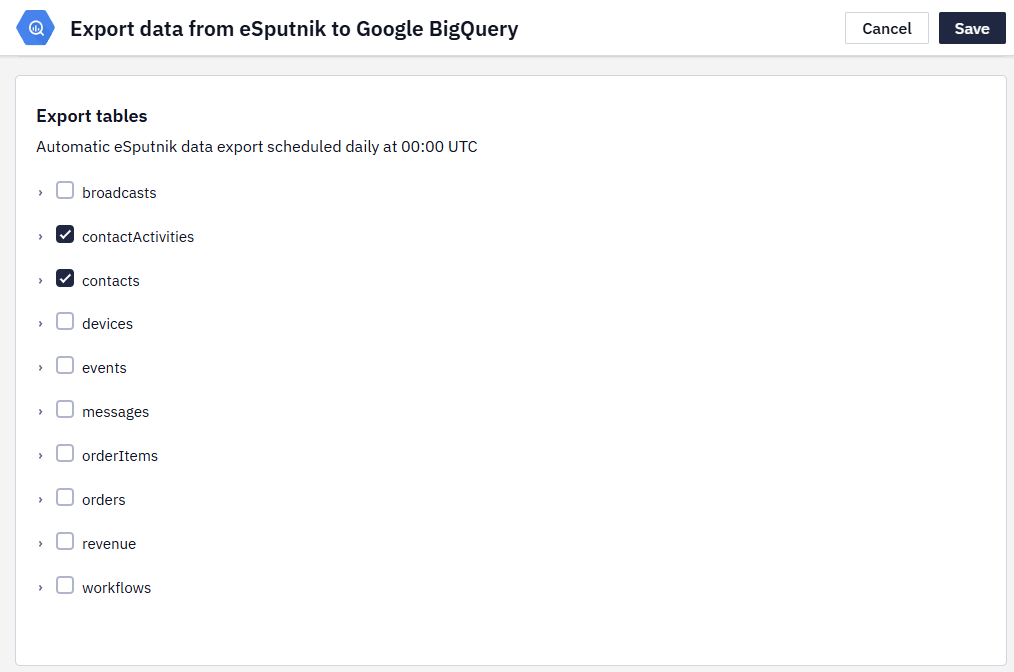
- Upload the key file and check the boxes for the data sets you want to upload. Click Save.
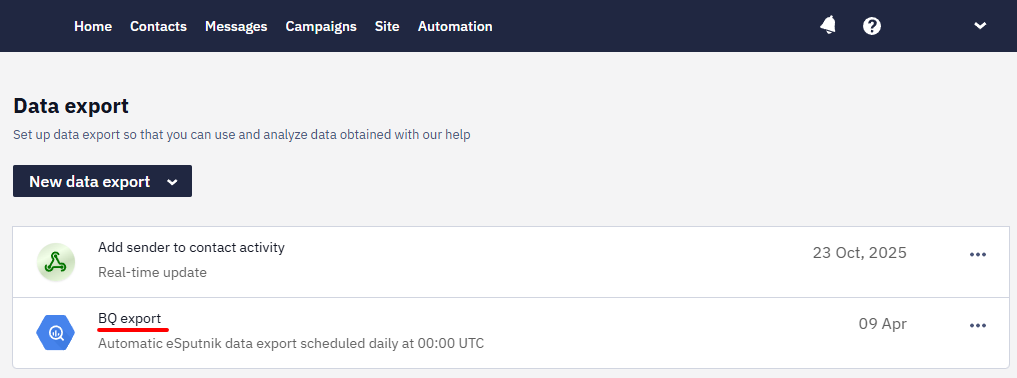
The connection will be displayed in the Data export section, here you can edit its settings.
List of Data Export Parameters
Broadcasts
| Parameter | Type | Description |
|---|---|---|
| createdDate | timestamp | Day and time of message creation (format: '2021-10-08 11:11:02') |
| groupId | int | Segment IDs participating in the broadcast |
| id | int | Broadcast ID |
| mediaType | string | Media type (Sms, Email, WebPush, Viber, MobilePush, AppInbox, Widget) |
| messageId | int | Message ID |
| name | string | Broadcast name |
| startedDate | timestamp | Day and time of broadcast sending (format: '2021-10-08 11:11:02') |
| status | string | Broadcast statuses: • IDLE - completed; • RUNNING - started; • PAUSED - paused (if the mailing was not stopped manually by you, contact support for more details); • SCHEDULED - planned; • UNCONFIRMED - in queue for moderation; • CONSIDERATION - under moderation; • BLOCKED - blocked by moderator. |
| updatedDate | timestamp | Day and time of broadcast updating (format: '2021-10-08 11:11:02') |
ContactActivities
| Parameter | Type | Description |
|---|---|---|
| activity (activityStatus) * | string | Activity status:
|
| broadcastId | int | Broadcast ID |
| campaignType | string | Campaign type:
|
| clickEventLink | string | Contains the link clicked by a contact (when the status is CLICKED) |
| contactId | int | Contact ID in Yespo (Internal) |
| errorCode (statusDescription) * | string | Delivery error and description. For UNDELIVERED email activities, this can contain a raw SMTP bounce reason, or a non-SMTP code such as UNSUBSCRIBED, BLACKLISTED, MEDIA_LOCATOR_FORBIDDEN, or GENERAL_EMAIL_ERROR. |
| eventKey | string | Event key |
| eventTypeKey | string | Event type key |
| eventId | string | ID of an event that had started a workflow |
| externalCustomerId | string | Contact ID in your system (External) |
| iid | string | Identifier of a particular send |
| mediaType | string | Media type (Sms, Email, WebPush, Viber, MobilePush, AppInbox, Widget, In-App, Telegram) |
| messageInstanceId | int | Service field |
| messageLanguageCode | string | Message language code |
| messageName | string | Message name in Yespo account |
| messageId | int | Message ID |
| imId | int | Individual message ID. Use this to associate contact activities with a specific message. |
| messageTags | string | Message tags |
| messageURL | string | Contains the link to the email web version |
| osName | string | Device operating system |
| osType | string | Device type |
| senderName | string | Viber sender name |
| started (activityDateTime) * | timestamp | Date and time of the activity: for the send, the time it was sent; for each later status, the time of that status (format: '2021-10-08 11:11:02') |
| utmCampaign | string | Campaign UTM. Read from the link the contact clicked, so the value is there only in rows with the CLICKED status. Rows with DELIVERED or READ carry no UTM, and there is no setting that changes this. |
| workflowId | string | Workflow ID |
| workflowInstanceId | string | The identifier of a particular workflow launch. Use it to group mailings within the launch of a workflow. |
| workflowBlockId | string | Workflow block ID |
| smsParts | int | Number of SMS parts |
*The field will be removed as overdated; use the field indicated in brackets
Contacts
| Parameter | Type | Description |
|---|---|---|
| contactId | int | Contact ID in Yespo (Internal) |
| contactSource string | string | Contact source: • SITE_AUTOMATED - binding an email to a push subscriber (webPush collection script), • I_MESSAGE - sending a single message, • CAMPAIGN - workflow (block Create contact or Add to segment), • IMPORT - file import or Add contacts method, • MANUAL - manually created, • SUBSCRIPTION - subscription form (Subscribe a contact API method), • Add contact API method, • ORDER - order on the site (Add orders API method). |
| createdDate | timestamp | Contact creation date and time (format: '2021-10-08 11:11:02') |
| string | Contact email | |
| emailDomain | string | Email domain |
| emailStatus | string | Email status |
| externalCustomerId | string | Contact ID in your system (External) |
| firstName | string | Contact first name |
| languageCode | string | Contact language code |
| lastClickedDate | timestamp | Day and time of the last click (format: '2021-10-08 11:11:02') |
| lastName | string | Contact last name |
| lastReceivedDate | timestamp | Day and time of the last delivery (format: '2021-10-08 11:11:02') |
| lastSentDate | timestamp | Day and time of the last sending (format: '2021-10-08 11:11:02') |
| lastViewedDate | timestamp | Day and time of the last opening (format: '2021-10-08 11:11:02') |
| sms | string | Phone number |
| marketId | varchar (100) | The market or branch identifier to which the contact belongs |
| totalClicked | int | Total clicks amount |
| totalReceived | int | Total received messages amount |
| totalSent | int | Total sent messages amount |
| totalViewed | int | Total viewed messages amount |
Devices
| Parameter | Type | Description |
|---|---|---|
| appVersion | string | App version |
| applicationId | int | App ID |
| category | string | Category |
| contactId | int | Contact ID |
| deviceId | string | Device ID |
| deviceModel | string | Device model |
| externalCustomerId | string | External customer ID |
| languageCode | string | Language code |
| osType | string | OS type |
| osVersion | string | OS version |
| pushToken | string | Push token |
| timeZone | string | Time zone |
Events
| Parameter | Type | Description |
|---|---|---|
| contactId | int | Contact ID |
| eventId | int | Event ID |
| eventTypeKey | string | Event type |
| keyValue | string | Event key |
| occured | timestamp | Date and time of occurrence (format: '2021-10-08 11:11:02') |
| paramsJson | json | 50 first event parameters and values (name/value); up to 300 characters of values are transferred. |
Note
- The number of rows in the
eventstable is not the same as the number of contacts — each occurrence of an event is exported as a separate row. A single contact can trigger the same event multiple times (for example, reinstalling the app on a new device, or using multiple devices), and events remain in the table even if the related contact is later deleted. Don't use event row counts as a proxy for unique contact counts.paramsJsonincludes only flat (top-level) event parameters. Nested parameters — where a parameter's value is itself an object (for example, asourcefield nested inside another parameter) — are not exported to BigQuery.
Messages
| Parameter | Type | Description |
|---|---|---|
| annoyanceLevel | int | Message annoyance level |
| language | string | Language of the main version of the message |
| mediaType | string | Media type (Sms, Email, WebPush, Viber, MobilePush, AppInbox, Widget, In-App) |
| messageId | int | Message ID |
| name | string | Message name |
| replyTo | string | Reply-to address |
| sender | string | Sender |
| subject | string | Subject |
| tags | string | Tags |
| translations | string | Language versions of the message |
| updateDate | timestamp | Day and time of message updating (format: '2021-10-08 11:11:02') |
NoteThe
messagestable row is populated when the message is exported and is not retroactively updated afterward. If you edit an already-exported message later (for example, adding a tag), that change won't be reflected in the existing row in BigQuery.
OrderItems
| Parameter | Type | Description |
|---|---|---|
| cost | float | Product price |
| description | string | Product description |
| externalProductId | string | External product ID |
| imageUrl | string | Product image link |
| name | string | Product name |
| orderDate | timestamp | Order creation date (format: '2021-10-08 11:11:02') |
| orderId | int | Order ID in Yespo (Internal) |
| quantity | int | Number of products |
| url | string | Product URL |
Orders
| Parameter | Type | Description |
|---|---|---|
| contactId | int | Contact ID in Yespo (Internal) |
| marketId | varchar (100) | Market ID |
| deliveryAddress | string | Delivery address |
| deliveryMethod | string | Delivery method |
| discount | float | Discount |
| string | ||
| externalOrderId | string | External order ID |
| firstName | string | Contact first name |
| lastName | string | Contact last name |
| orderCreatedDate | timestamp | Date of order creation in Yespo (format: '2021-10-08 11:11:02') |
| orderDate | timestamp | Order creation date (format: '2021-10-08 11:11:02') |
| orderId | int | Order ID in Yespo (Internal) |
| paymentMethod | string | Payment method |
| Phone | string | Phone number |
| Status | string | Order status: • INITIALIZED, • IN PROGRESS, • DELIVERED, • CANCELED. |
| totalCost | float | Total order cost |
Revenue
Activity for messages sent through the Send prepared message (smartsend) API resource is exported as well: such sends count as triggered messages, so campaignType is IM.
| Parameter | Type | Description |
|---|---|---|
| activity (activityStatus)* | string | Activity status: • DELIVERED – the message was delivered. • UNDELIVERED – the message was undelivered (statusDescription contains the reason). • READ – the message was opened. • UNSUBSCRIBED – a contact unsubscribed from the broadcasting list. • CLICKED – a contact clicked links in the message. • SPAM – a contact reported spam. • SUBSCRIPTION_CHANGED – a contact changed the subscription category. • PUSH_SUBSCRIBED — a contact subscribed to push notifications. |
| campaignType | string | Campaign type: • IM — triggered message, • Group — broadcast. |
| clickEventLink | string | Contains the link clicked by a contact (when the status is CLICKED) |
| contactId | int | Contact ID in Yespo (Internal) |
| currency | string | Currency |
| externalCustomerId | string | Contact ID in your system (External) |
| externalOrderId | string | External order ID |
| mediaType | string | Media type (Sms, Email, WebPush, Viber, MobilePush, AppInbox, Widget) |
| messageInstanceId | int | Service field |
| messageName | string | Message name in Yespo account |
| messageTags | string | Message tags |
| messageUrl | string | Contains the link to the email web-version |
| orderDate | timestamp | Order creation date (format: '2021-10-08 11:11:02') |
| senderName | string | Viber sender name |
| started (activityDateTime)* | timestamp | Date and time of the activity: for the send, the time it was sent; for each later status, the time of that status (format: '2021-10-08 11:11:02') |
| totalCost | float | Total order cost |
| utmCampaign | string | Campaign UTM. Filled only for click activity — the value comes from the link the contact clicked |
| eventKey | string | Event key |
| eventTypeKey | string | Event type key |
| messageLanguageCode | string | Message language code |
| orderId | int | Order ID in Yespo (Internal) |
| workflowId | int | Workflow ID |
| broadcastId | int | Broadcast ID |
*The field will be removed as overdated; use the field indicated in brackets
NoteExisting entries in the Revenue table (for orders placed after 03.08.2024) can be updated along with the upload of new orders. Updating may be necessary, for example, if the total cost of the order has changed.
Workflows
Parameter | Type | Description |
|---|---|---|
| createdDate | timestamp | Workflow creation date |
| status | varchar (100) | Workflow status (active/inactive) |
| updatedDate | timestamp | Workflow update date |
| workflowId | int | Workflow ID |
| workflowName | varchar (100) | Workflow name |
Use Cases
Here are some key use cases for exporting data from Yespo to BigQuery:
1. Advanced Campaign Performance Analysis
- Dataset Used: broadcasts, contactActivities, messages.
- Description: BigQuery enables ecommerce teams to analyze campaign performance in-depth, tracking key metrics such as open and click-through rates. Exporting data on broadcasts, including segmentation criteria, delivery status, and message type, allows marketers to assess which campaigns achieve the best engagement.
- Use Case Benefit: By identifying the most effective campaigns, marketers can optimize message content, timing, and audience targeting, enhancing the impact and ROI of future campaigns.
2. Customer Segmentation and Behavioral Analytics
- Dataset Used: contacts, contactActivities, events.
- Description: BigQuery can process large volumes of customer activity data, enabling ecommerce brands to spot behavioral patterns such as purchase frequency or preferred interaction channels. This insight allows for deeper segmentation, making it possible to target highly engaged customers more accurately.
- Use Case Benefit: Tailored, behavior-driven campaigns lead to increased customer retention and higher lifetime value (LTV) by delivering experiences that resonate with each audience segment.
3. Personalization and Retargeting
- Dataset Used: devices, contacts, contactActivities, events.
- Description: By exporting data on user devices, engagement history, and past interactions, ecommerce teams can implement personalized retargeting. For instance, messaging can be tailored to recent activity or device type to enhance relevance and engagement.
- Use Case Benefit: Personalizing messages based on user actions and preferences improves user experience, boosts conversions, and builds a more dynamic engagement strategy.
4. Predictive Modeling
- Dataset Used: contacts, orders, revenue, contactActivities.
- Description: Historical data on revenue, purchases, and engagement in BigQuery allows for the development of predictive models to forecast customer churn. This enables brands to identify at-risk customers and target them with retention strategies.
- Use Case Benefit: Targeted retention campaigns reduce churn and increase LTV, helping brands retain valuable customers and improve long-term revenue.
5. Order and Revenue Analysis for Strategic Insights
- Dataset Used: orders, orderItems, revenue.
- Description: By analyzing order and revenue data in BigQuery, ecommerce businesses can track metrics such as average order value and revenue trends. This analysis helps identify upselling and bundling opportunities.
- Use Case Benefit: Insights into revenue patterns allow for data-driven decisions on pricing, promotions, and product offerings, maximizing revenue potential.
6. Monitoring and Alerting on Key Metrics
- Dataset Used: broadcasts, contactActivities, revenue.
- Description: BigQuery dashboards can monitor key performance indicators (KPIs) such as engagement levels and revenue trends, with the ability to set up alerts for significant changes (e.g., a sudden drop in delivery rates).
- Use Case Benefit: Monitoring helps maintain campaign effectiveness by allowing teams to quickly address performance issues, ensuring consistent engagement.
7. Campaign ROI and Budget Allocation Analysis
- Dataset Used: broadcasts, orders, revenue, contactActivities,
- Description: Exporting campaign and revenue data into BigQuery allows ecommerce marketers to calculate ROI and assess campaign cost-effectiveness, providing guidance on optimal budget allocation.
- Use Case Benefit: By focusing on high-performing campaigns, marketers can optimize spending to maximize marketing effectiveness and returns.
8. Customer Journey Mapping Across Channels
- Dataset Used: contacts, contactActivities, events, orders.
- Description: BigQuery’s data processing capabilities enable brands to consolidate user journeys across channels, providing insights into the customer lifecycle from discovery to conversion.
- Use Case Benefit: Understanding the customer journey reveals drop-off points and highlights opportunities for improvement, supporting a smoother experience and higher conversion rates.
Message status descriptions
The statusdescription field explains why a message was not sent or delivered:
| Value | Meaning |
|---|---|
UNSUBSCRIBED | The contact unsubscribed from the relevant channel. |
BLACKLISTED | The contact or media locator is blacklisted. |
MEDIA_LOCATOR_FORBIDDEN | Sending to the media locator is blocked at the system level. |
GENERAL_EMAIL_ERROR | A general email sending error. Inspect the message activity or contact support for the case-specific cause. |
A null value means that no status description was recorded. Do not treat every non-null value as a delivery failure without also checking the message status.
Updated 20 days ago